
PART 1: UNDERSTANDING THE BASICS OF VOCATION DISCERNMENT
INTRODUCTION TO VOCATION DISCERNMENT
The task of recruitment and enlistment to ordained ministry, as defined in the Book of Discipline, is embedded in the functions of the Board of Ordained Ministry. Hence, the Board of Ordained Ministry, shall, with the assistance of the local church Pastor/Staff Parish Relations Committee, ” enlist men and women of all races and ethnic origins for the ordained ministry and guide those persons in the process of education, training, and ordination…” (¶ 635.2.a of the 2016 BOD)
To carry out this task of enlistment, the Book of Discipline requires all candidates for licensed and ordained ministry to undergo a process called “Orientation to Ministry.” (¶312) The purpose of this common ministry preparation is to build collegiality and understanding among the varieties of set-apart ministry (deacons, elders, local pastors).
In 2012, the Board of Ordained Ministry handbook provides for the election of the Vocation Discernment Coordinator (BOM Handbook Section 2- Chapter 4) to implement and oversee the vocation discernment process through an adopted program of the Annual Conference Board of Ordained Ministry.
ISSUES AND CONCERNS ON VOCATION DISCERNMENT
As a requisite in recruitment and enlistment for the ordained ministry, the true essence of being set-apart is a major consideration. Hence these are salient observations to be addressed:
- A seemingly lack of understanding/training of the Pastor/Staff Parish Relations Committee about the process of vocation discernment and the processes of recruitment and enlistment.
- Those who have expressed their intentions to enlist are not properly guided due to the lack or absence of a vocation discernment program.
- During interviews for licensing and candidates of ordination, some are having difficulties in articulating their calling discernment.
- In some cases, those who have been licensed for several years have limited understanding of the varieties of set-apart ministry (local pastors, deacons, elders).
Perhaps, if these issues and concerns will be discussed thoroughly, possible items may be added to the list mentioned above.
LEGISLATIVE UNDERSTANDING OF VOCATION DISCERNMENT: OUR RESPONSE
As mentioned earlier, in response to the growing needs of quality understanding of set-apart ministry, the following were so far institutionalized in the Board of Ordained Ministry Structure and Programs has been:
1. The election of Vocation Discernment Coordinator within the structure of the Annual Conference Board of Ordained Ministry. The General Board of Higher Education Ministry (GBHEM) as incorporated in the Board of Ordained Ministry Handbook in 2012 states the provision of electing or naming a Vocation Discernment Coordinator in the structure of the Board of Ordained Ministry. The incorporation of this position is further fortified in ¶ 635.1.c of the 2016 Book of Discipline.
The Vocation Discernment Coordinator shall:
a. Coordinate the candidacy mentoring process and to work within the Board of Ordained Ministry to encourage and provide resources for those discerning a call to ministry.
b. Work with the BOM, dCOMs, and District Superintendents to coordinate, implement, and strengthen the candidacy process throughout the Annual Conference, including recruiting, training, and assigning mentors to new candidates.
c. Build connections among dCOMs, BOM, and the District Superintendents by providing correct information that is consistent, helpful, and timely for everyone involved in the candidacy mentoring process.
2. The Conduct of Orientation to Ministry as a Requirement
“An orientation to ministry is required for all candidates for licensed and ordained ministry. Attendance at the orientation and becoming a certified candidate may be sequential or concurrent. This common ministry preparation experience purposively is to build collegiality and understanding among the varieties of set-apart ministry (deacons, elders, local pastors)” – ¶ 312
It is suggested that a Certificate of Attendance be required as proof that a candidate for licensing and ordination has completed the Orientation to Ministry process.
3. Candidacy Mentoring
Part of the discernment vocation response by the Board of Ordained Ministry is to ensure that candidates for licensing and ordination have provisions for mentoring. “Mentors shall be recommended by the cabinet, selected, trained and be held accountable by the Board of Ordained Ministry…” ¶ 348
These are two categories of a mentor:
1. Candidacy mentors are clergy in full connections that are trained to provide counsel and guidance to the candidacy process. Candidates will be assigned to a candidacy mentoring group or a candidacy mentor by the dCOM in consultation with the District Superintendent. Further, they will be assigned to a candidacy mentor or mentoring groups to meet with until they begin serving as a local pastor or provisional member.
2. Clergy mentors are clergy in full connection, associate members, and full-time or part-time local pastors who have completed the Course of Study that are trained to provide ongoing oversight and counsel with local pastors and with provisional members.
For purposes of coordination and coherence in program implementation, the mentoring process shall be coordi- nated with the Vocation Discernment Coordinator of the Annual Conference.
PART 2: IMPLEMENTING THE VOCATION DISCERNMENT PROGRAM
VOCATION DISCERNMENT PROGRAM DESIGN
A good and comprehensive Vocation Discernment Program Design entails to address the following concerns:
A. Practicability of the Vocational Discernment Program. The design of the program must be doable in its implementation.
B. Accountability of the identified persons who will oversee the program. The design includes the accountabilities of the point-persons at all levels (local church, district, and Annual Conference). It is therefore suggested that in designing the Vocation Discernment Program, an entity or a point-person be appointed for this purpose.
C. Continuity of the modules starting from the local church, district, and Annual Conference levels. Vocation Discernment Modules must be organized and systematic at the local church, district, and Annual Conference levels, respectively.
SUGGESTED VOCATION DISCERNMENT PROGRAM MODELS
A. PATHWAYS TO CHURCH LEADERSHIP MODEL
(Level I – Local Church)
The Pathways to Church Leadership Model aims to provide a discerning process for laypeople, particularly for new local church lay servants and for those who have been certified by the District Committee on Lay Servant Ministry. The model differentiates the lay servant ministry from the set-apart or the ordained ministry.
The modules include among others the following:
1. Introduction to Lay Servant Ministries (Basic LSM Course)
2. Living Our United Methodist Beliefs
3. United Methodist Polity
4. Discovering Your Spiritual Gifts
5. Lay Servant Ministry and the Ordained Ministry
The Discipleship Resources of the United Methodist Church has released numerous materials to support these modules. The outcomes of this Model include:
- Identification of gifts for church ministry and leadership succession.
- Lay Servants discerning their lay ministry focus (Lay Speaker, Lay Missioner, Lay Minister)
- Initial discernment of people praying for licensed and ordained ministry. The Pastor/Staff Parish Relations Committee and the Administrative Pastor served as Vocation Discernment Mentors and Coaches.
B. ORIENTATION TO MINISTRY MODEL
(Level II- District Level)
The Orientation to Ministry Model is applicable for those who have been endorsed and approved by the local church as inquiring and exploring candidates for licensing and ordaining ministry. The candidates should be a licensed Lay Speaker or a Certified Lay Servant for one year by the District Committee on Lay Servant Ministry or have completed at least the Pathways to Church Leadership Program.
Aside from completing the Pathways to Church Leadership Program or the Certification on Lay Servant Ministry program, inquiring and exploring candidates-as part of the vocation discernment program shall com- plete the following:
1. Pre-Licensing Course with the following modules:
a. Christian as a Minister
b. Discovering Spiritual Gifts
2. Orientation to Ministry for Licensing Candidate The District Committee on Ordained Ministry and the District Superintendent shall name a point person under the supervision of the DCOM to oversee this second level of the Vocation Discernment Program. Candidacy men- tors under ¶ 348 shall likewise be applied.
C. VOCATION DISCERNMENT RETREAT
(Annual Conference Level)
The Vocation Discernment Retreat is the third level of the Vocation Discernment Program designed for candidates to the ministry as endorsed by the District Committee on Ordained Ministry (DCOM) and for those who are applying for the commissioning/provisional status.
This is a 3-day retreat with the following objectives:
DAY 1 – LISTEN
a. To provide the participants a quality time to listen and reflect on God’s calling to set-apart ministry or ordained ministry.
b. To deepen one’s understanding of the concept of vocation and its impact on the life and mission of the Church (Missiology and Ecclesiology)
c. To intensify the concept of vocation and its impact to the life and mission of the Church (Missiology and Ecclesiology)
DAY 2- DISCERN
a. To discern the gifts and abilities from God and be able to match these gifts to the needs of the Church and its mission.
b. To devote more time on prayer to seek God’s leading for set-apart ministry.
c. To understand comprehensively the ordained ministry and its orders (Deacon, Elder) to discern their specific vocation.
DAY 3- RESPOND
a. To come up with a personal decision to consecrate themselves to set-apart ministry.
b. To affirm their response through a “consecration service.”
PART 3: STRENGTHENING VOCATION DISCERNMENTIN THE DISCIPLESHIP ARENA
The above interventions made to effect an operative Vocation Discernment Program are quite helpful in terms of structure and accountabilities. However, in the Philippine setting, we need to consider also some measures to bolster an intentional recruitment and enlistment program starting from the source of recruitment arenas- the local church, the Christmas Institute, the Young People Assembly, the Campus Ministries, etc.
At the local church level, the Pastor/Staff-Parish Relations Committee should have a better grasp in understanding the vocation discernment process, including the processes attached thereof. A well-informed and well-trained Pastor/Staff Parish Relations Committee at the local church level increases the chance of having the well-deserved candidates.
In other areas of discipleship-making such as the small group ministries, Christmas Institute, Young People Assemble, Campus Ministries and the like, an intentional Vocation Discernment Program inclusion is considerably important. For example, the recruitment process used during the institutionalized Christmas Institute program. Every Christmas Institute held each year, there have been numerous young people who have expressed their intention to be pastors, missionaries, or deaconesses in the present or near future. However, after the Christmas Institute, there is no one held accountable to invite them to the next higher level of understanding the process of vocation discernment. Thus, the inclusion of vocation discernment in the Christmas Institute is a rich ground for recruitment.
To strengthen the inclusion of Vocation Discernment in the discipleship-making arena, the following is worth to ruminate:
1. Vocation Discernment as a systemic program.
It should be systemic in nature because one of the goals of discipleship-making is to produce more committed workers for the mission of the Church. Vocation Discernment plays a pivotal and influential role for lay- people to understand and differentiate the set-apart ministry and the lay servant ministry. Adding the component of this vocation discernment in the discipleship processes will afford our laypeople a path to progress on discerning their calling and their placement in the ministries of the church and to the world. A systemic Vocation Discernment Program put in place in local churches, districts and Annual Conferences increases not only the quality of our recruitment and enlistment processes but as well as the number of well-informed candidates.
2. Vocation Discernment as an inclusive program.
While the focus of the recruitment and enlistment of set-apart ministry is for young people, it cannot be discounted that everyone in the community of faith should have a place in the ministry. Those who have seen themselves far from the set-apart ministry should be offered to engage in various lay servant ministries (Lay Speaker, Lay Missioner, Lay Minister).
3. Vocation Discernment as an intentional program.
Without intentionality, all responses would be reactive. A rigid yet well-founded process would definitely result in a solidified product. The role of Vocation Discernment Coordinator at the Annual Conference level plays an important part to make it happen. A properly coordinated program at the local church and the district levels accompanied by intentional monitoring and evaluation tools would strengthen our recruitment and enlistment processes.
CONCLUDING STATEMENT
Quality results emanate from with quality systems and processes. To raise the quality of pastors distinguished image, the ultimate intention is to produce spiritual leaders who are committed, competent and passionate to uphold the mission of the Church, and to make disciples of Jesus Christ for the transformation of the world.
CANDIDACY PROCESS
¶ 310 TO BECOME A CERTIFIED CANDIDATE
THE PROCESS
1. Obtain a high school diploma or its equivalency (submit copy of Diploma or Transcript of Records).
2. Be a member of The United Methodist Church, or an active, baptized participant in a United Methodist ministry setting, for at least one year. Membership/ participation must be active when entering the process. The District Committee on Ordained Ministry (DCOM) and District Superintendent (DS) may confirm appropriate areas of participation. Indicate date of active church membership if applicable.
3. Contact a clergyperson in their local church, another clergy, or the district superintendent of the district in which they participate in a United Methodist ministry setting to inquire about the process of candidacy.
4. Meet with District Superintendent to share call story.
5. Attend Orientation to Ministry (¶312) Submit certificate for documentation.
6. Read The Christian as Minister, then talk with the candidate’s pastor, a collegiate minister, or another deacon, elder, or local pastor about his/her call.
7. Submit (1) statement of call and (2) a letter expressing desire to enter Candidacy.
8. Answer Wesley’s Historic Questions. Historic questions found in the BOD ¶310.1. d.
a. Do they know God as pardoning God? Have they the love of God abiding in them? Do they desire nothing but God? Are they holy in all manner of conversation?
b. Have they gifts, as well as evidence of God’s grace, for the work? Have they a clear, sound understanding; a right judgment in the things of God; a just conception of salvation by faith? Do they speak justly, readily, clearly?
c. Have they fruit? Have any been truly convinced of sin and converted to God, and are be- lievers edified by their service?
10. Receive charge conference approval (church or other approved ministry setting) to enter the candidacy process. If approved by the SPRC, arrange for a recommendation as a candidate for ministry to be taken to a meeting of the Charge Conference, in accordance with paragraph 310.1.e. Charge Conference vote to be determined by written ballot with at least 3/4 of those present and eligible voting for approval. Officially submit to the DCOM registrar a copy of the Charge Conference minutes indicating the vote of approval.
11. Meet with district committee to discuss his/her one- page statement of call. The candidate is welcome to invite the SPRC Chair or Pastor to accompany him/her to the “meet and greet” interview with the DCOM.
12. District Superintendent responds and sends Biographical Form 102, and requests the candidate to submit this form to the DCOM registrar.
13. The DCOM and the DS assign a mentor.
14. Meet with trained mentor.
15. The candidate should submit to the DCOM the following:
a. written Autobiographical Essay
b. written Religious Development Essay
c. National Bureau Investigation (NBI) Clearance
d. Notarized Candidate’s Disclosure Form.
e. Medical Summary Report.
f. Statement of Family Support.
g. A complete psychological assessment [only after the recommendation has been made by Charge Conference and DCOM].
h. A request to interview for certified candidacy with the DCOM.
i. A received 3/4 vote approval of DCOM to become certified (written ballot, ¶ 666.6).
j. A receive annual charge conference and DCOM approval to continue as a certified candidate.
Continuation as a Certified Candidate (¶ 313)
1. Orientation to Ministry (¶312)
- An attendance BOM-sponsored event which is required for all candidates
- Offers a place where those discerning a call can receive a clear explanation of the various types of ministry
- Builds collegiality among those interested in serving in different types of ministry
- Takes place early in the candidacy process, either before or after certification depending on the decision of the BOM
2. A certified candidate may continue in this status under the supervision of the DCOM for one to 12 years before becoming a provisional member of the Annual Conference, receiving an appointment as a local pastor, withdrawing or being discontinued from candidacy for licensed or ordained ministry. (¶314, ¶324.1)
3. During this aforementioned time, candidates, shall continue to work with Candidacy Mentors who monitor the candidates’ educational, spiritual and vocational goals.
FLEXIBILITY OF CANDIDACY PROCES
1. Applicants must complete all requirements in ¶310 before becoming a certified candidate. However, the timing of the steps may be altered.
- Some candidates have already made most of their vocational decisions and are preparing for ordination as a deacon or an elder through college or seminary studies.
- Some candidates may be deciding how they are called to pursue ministry as a second career, entering candidacy with English as a second language or discerning among local pastor, elder or deacon ministry.
2. It is important to consider personal background, experience, education, training and circumstances. Allow flexibility to move through the candidacy process (¶310.2b).
3. Most candidates will likely meet with a mentor before being recommended as a candidate by the P/S-PRC and the charge conference (or equivalent bodies). However, some candidates may receive a charge conference recommendation before applying for candidacy through the DS. Conferences may be flexible with the order in which a candidate moves through the beginning stages of candidacy, provided that the requirements of ¶310 have been completed prior to certification by the DCOM.
¶ 315 TO BECOME A LOCAL PASTOR AND BE LICENSED
1. To become a certified candidate:
2. To become a certified candidate:
a. Written Autobiographical Essay
b. Written Religious Development Essay
c. NBI Clearance
d. Notarized Candidate’s Disclosure Form
e. Medical Summary Report
f. A complete Psychological Assessment
g. A Scholastic Transcript of Records
h. A Statement of family support
I. A mentor’s Report
j. A DS evaluation and recommendation A Bible Study, a sermon, and a Sunday liturgy.
3. Further, he/she shall:
a. Have successfully completed a Licensing School in addition to Four Course of Study courses or 1/3 of a Master of Divinity degree, including one course in United Methodist history, doctrine, or polity.
b. Have been recommended by a ¾ majority of the DCOM.
c. Have been approved by a ¾ majority vote of the BOM.
d. Have received approval for licensing by a ¾ majority vote of the clergy session.
e. Have received an appointment from the bishop.
CONTINUANCE AS A LOCAL PASTOR (¶ 319)
1. Persons licensed as local pastors who are not provisional members shall continue in college, in a program of theological education at an approved seminary, or in the Course of Study.
2. Upon completing each year’s education and other qualifications, a local pastor who is not a provisional member may be recommended for continuance by the district committee on ordained ministry. The clergy members in full connection of the annual conference may approve continuance of a local pastor after reference to and recommendation by its BOOM.
3. A full-time local pastor shall complete the Course of Study curriculum within eight years and a part-time local pastor within 12, unless a family situation or other circumstance precludes the local pastor’s opportunity to meet said requirements. The local pastor may be granted an annual extension beyond the prescribed limit upon a 3/4 vote of the DCOM, recommendation by the conference BOOM, and the vote of the clergy members in full connection.
4. A local pastor shall submit the following:
a. Annual pastoral evaluation
b. NBI Clearance
c. Notarized Candidate’s Disclosure Form
d. Medical Summary Report
e. A Complete Psychological Assessment
f. A Scholastic Transcript of Records
g. A Statement of Family SupportA Mentor’s Report
h. A DS Evaluation and Recommendation
I. Manuscripts of three sermons preached in a worship service with corresponding bulletins
5. Further, he/she shall:
a. Have a Lesson Plan and an outline for an original Bible study. (It can be taught by a substitute leader. Needs to have a goal or purpose and show depth of Biblical research.)
b. Have an updated religious development essay.
c. Finally, a local pastor may choose to remain in a local relationship with the annual conference upon having completed the Course of Study.
¶ 322 TO BECOME AN ASSOCIATE MEMBER
1. Been a certified candidate for at least one year. Those appointed as local pastors are clergy members of the annual conference and are no longer certified candidates (¶ 311).
2. A candidate shall submit to the DCOM and BOOM the following:
a. Written Autobiographical Essay
b. Written Religious Development Essay
c. NBI Clearance
d. Notarized Candidate’s Disclosure Form
e. Medical Summary Report
f. A complete Psychological Assessment
g. A scholastic Transcript of Records (at least Bachelor’s degree)
h. A statement of Family Support
I. A Mentor’s Report
j. A DS Evaluation and Recommendation
k. Manuscripts of three sermons preached in a worship service with corresponding bulletins
3. Further, he/she shall:
a. Have a Lesson Plan and an outline for an original Bible study. (It can be taught by a substitute leader. Needs to have a goal or purpose and show depth of Biblical research.)
b. Have responded to a written and oral doctrinal examination administered by the BOOM. Part of the exam shall be ¶ 324.9 a-p.
c. Have demonstrated gifts for ministries of service and leadership to the satisfaction of the DCOM and BOOM.
d. Have been interviewed by the Board of Ordained Ministry and recommended to the clergy session by 3/4 majority vote of the Board (¶ 324.14).
¶ 324 TO BECOME A PROVISIONAL MEMBER VIA GRADUATE EDUCATION
1. Been a certified candidate for at least one year. Those appointed as local pastors are clergy members of the annual conference and are no longer certified candidates (¶ 311).
2. A candidate shall submit to the DCOM and BOOM the following:
a. Written Autobiographical Essay
b. Written Religious Development Essay
c. NBI Clearance
d. Notarized Candidate’s Disclosure Form
e. Medical Summary Report
f. A complete Psychological Assessment
g. A scholastic Transcript of Records (at least Bachelor’s degree)
h. A statement of Family Support
I. A Mentor’s Report
j. A DS Evaluation and Recommendation
k. Manuscripts of three sermons preached in a worship service with corresponding bulletins
3. Further, he/she shall:
a. Have a Lesson Plan and an outline for an original Bible study. (It can be taught by a substitute leader. Needs to have a goal or purpose and show depth of Biblical research.)
b. Have responded to a written and oral doctrinal examination administered by the BOOM. Part of the exam shall be ¶ 324.9 a-p.
c. Have demonstrated gifts for ministries of service and leadership to the satisfaction of the DCOM and BOM.
d. Have been interviewed by the Board of Ordained Ministry and recommended to the clergy session by 3/4 majority vote of the Board (¶ 324.14).
¶ 330 TO BECOME A FULL MEMBER DEACON
1. Been a certified candidate for at least one year. Those appointed as local pastors are clergy members of the annual conference and are no longer certified candidates (¶ 311).
2. A candidate shall submit to the DCOM and BOOM the following:
a. Written Autobiographical Essay
b. Written Religious Development Essay
c. NBI Clearance
d. Notarized Candidate’s Disclosure Form
e. Medical Summary Report
f. A complete Psychological Assessment
g. A scholastic Transcript of Records (at least Bachelor’s degree)
h. A statement of Family Support
i. A Mentor’s Report
j. A DS Evaluation and Recommendation
k. Manuscripts of three sermons preached in a worship service with corresponding bulletins.
3. Further, he/she shall:
a. Have a Lesson Plan and an outline for an original Bible study. (It can be taught by a substitute leader. Needs to have a goal or purpose and show depth of Biblical research.)
b. Have responded to a written and oral doctrinal examination administered by the BOOM. Part of the exam shall be (¶ 324.9 a-p.)
c. Have presented a project that demonstrates fruitfulness in carrying out the church’s mission of “Making Disciples of Jesus Christ for the Transformation of the World.”
d. Have been previously elected as a provisional member.
4. Have completed the education requirements:
a. Graduation with a Bachelor of Arts or equivalent degree from a college or university listed by the University Senate or its equivalent as determined by the General Board of Higher Education and Ministry;
b. Graduation with a Master of Divinity degree or a master’s degree from a graduate theological school recognized by the University Senate, or a master’s degree in an area of specialized ministry;
c. Or are candidates over the age of 35 with professional certification or license in their area of ministry including a minimum of eight semester hours of graduate academic credit. Educational requirements in every case shall include the completion of the basic graduate theological studies of the Christian faith, as outlined in ¶ 324.4a.
5. Been a provisional member for at least two years following the completion of the educational requirements for ordination as a deacon.
6. Shall have served under episcopal appointment in a ministry of service for at least two full annual conference years.
7. Have been interviewed by the Board of Ordained Ministry and recommended to the clergy session by 3/4 majority vote of the Board.
8. Have received a 3/4 majority approval of the clergy session, participate in ordination service, and be ordained by a Bishop.
¶ 335 TO BECOME A FULL MEMBER ELDER
1. Been a certified candidate for at least one year. Those appointed as local pastors are clergy members of the annual conference and are no longer certified candidates (¶ 311).
2. A candidate shall submit to BOOM the following:
a. Written Autobiographical Essay
b. Written Religious Development Essay
c. NBI Clearance
d. Notarized Candidate’s Disclosure Form
e. Medical Summary Report
f. A complete Psychological Assessment
g. A scholastic Transcript of Records (at least Bachelor’s degree)
h. A statement of Family Support
i. A Mentor’s Report
j. A DS Evaluation and Recommendation
k. Manuscripts of three sermons preached in a worship service with corresponding bulletins
3. Further, he/she shall:
a. Have a Lesson Plan and an outline for an original Bible study. (It can be taught by a substitute leader. Needs to have a goal or purpose and show depth of Biblical research.)
b. Have responded to a written and oral doctrinal examination administered by the BOOM. Part of the exam shall be (¶ 324.9 a-p.
c. Have presented a project that demonstrates fruitfulness in carrying out the church’s mission of “Making Disciples of Jesus Christ for the Transformation of the World.”
d. Have been previously elected as a provisional member.
4. Have completed the education requirements:
a. Graduation with a Bachelor of Arts or equivalent degree from a college or university listed by the University Senate, or demonstrated competency equivalence through a process designed in consultation with the General Board of Higher Education and Ministry;
b. Graduation with a Master of Divinity degree from a school of theology listed by the University Senate, or its equivalent as determined by the General Board of Higher Education and Ministry; or
c. Met the education requirements of ¶ 324.6 for local pastors;
d. Educational requirements in every case shall include completion of the basic graduate theological studies of the Christian faith as outlined in ¶ 324.4a;
5. Served under episcopal appointment as a provisional member for at least two full annual conference years following the completion of the educational requirements for ordination as an elder.
6. Interviewed by the Board of Ordained Ministry and recommended to the clergy session by 3/4 majority vote of the Board.
7. Received a 3/4 majority approval of the clergy session, participate in ordination service, and be ordained by a Bishop.
COURSE OF STUDY FOR EXCEPTIONAL CASES
The Division on Ordained Ministry recognizes that due to cultural, economic, geographical, ethno-linguistic and other limitations, many UMC church workers fail to make any progress in their conference relations and status. Many of these pastors are assigned in remote areas serving indigenous communities. What can we do for them?
In response to their ministry contexts, the Division is committed to serve the needs of Candidates to the Ministry who prayerfully desire to become licensed as Local Pastors and even to be commissioned as Provisional Members and ordained as Elders or Deacons. In spite of the fact that they do not satisfy the general policy mandated by the Division in accordance with the standards of the Book of Discipline, we affirm the responsibility of the Church to help these brothers and sisters advance in their ministerial training and conference status.
Under ordinary circumstances they would be more than willing and ready to go through the requirements of the Book of Discipline. But in the course of our discussion, it must be recognized that there is a need to identify these workers as exceptional cases who must undergo the Course of Study for Ordained Ministry. These exceptional cases include those who belong to any one [1) of the following:
1. Functionally literate indigenous people who are called primarily to serve their own ethno-linguistic communities regardless of educational attainment;
2. Those who are officially retired from their secular career or profession;
3. Those who reached the age of 40 and who should be at least high school graduates;
4. Those who are differently able;
5. Those who have rendered at least ten [10) years of service and who have finished the Basic Course of Study for Local Pastors are qualified to take the Advanced Course of Study.
Those who fall within the category of exceptional cases are given the opportunity to advance in their ministerial standing and credentials by undergoing the Basic and Advanced Courses of Study.
It must be clear that Boards of Ordained Ministry shall not recommend church workers to undergo the Basic and Advanced Courses of Study although they fall within the parameters of these categories of exceptional cases if they have the capacity and credentials to finish their pre-theological and theological degrees in government and UMC- recognized institutions.
PROCESS
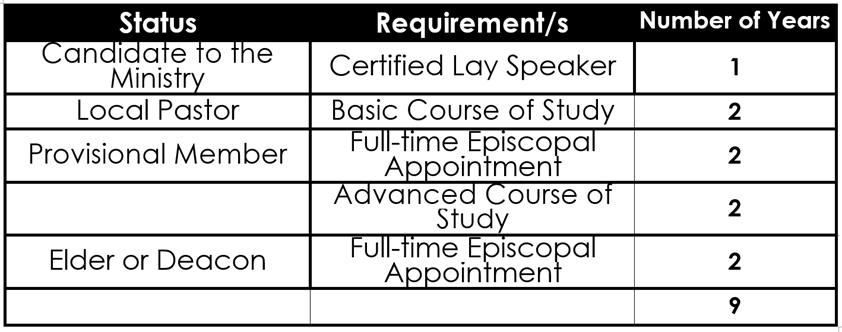
The Division of Ordained Ministry hereby outlines the process through which church workers can progress from one level of conference relations to another through the Course of Study program.
1. Candidates to the Ministry
1. 1. Candidates to the Ministry must be Licensed Lay Speakers.
1.2. They must be actively involved in local church and district level ministries.
2. Local Pastors
2.1 To be licensed as Local Pastors, Candidates to the Ministry must finish the Basic Course of Study for two (2) years.
3. Provisional Members
3.1 Local Pastors must have served at l e a s t two (2) consecutive years under full-time Episcopal appointment before they can qualify to take the Advanced Course of Study.
3.2. Local Pastors must finish the Advanced Course of Study for two (2) years.
3.2. After 3.1 and 3.2 are fulfilled, Local Pastors can be commissioned as Provisional Members.
4. Elders or Deacons
4.1. Provisional Members must serve at l e a s t two (2) years under full-time Episcopal appointment after they finished t h e Advanced Course of Study.
4.2. Provisional Members are ordained as Elders or Deacons after 4.1 is fulfilled.
The process can be simplified and tabulated as follows:
BASIC COURSE OF STUDY (BCOS)
Each subject in the Basic and Advanced Courses of Study shall be taught in at least 32 contact hours.
First Year – First Semester
- The Pastor as Interpreter of the Bible
- Theology in the Wesleyan Spirit
- Pastoral Care for Spiritual Formation
- Pastoral Leadership and Administration
- Hebrew Bible 1
First Year – Second Semester
- Theological Heritage: Early and Medieval
- Formation for Discipleship
- Practice of Preaching
- Hebrew Bible 2
- Theological Heritage: Reformation
Second Year – First Semester
- Our Mission: Evangelism
- Pastoral Care and Counseling
- New Testament 1
- Wesleyan Movement
- Worship and Sacraments
Second Year – Second Semester
- Personal and Social Ethics
- New Testament 2
- Contemporary Theology
- Our Mission: Transforming Agent
- Theology and Practice of Ministry
ADVANCE COURSE OF STUDY (ACOS)
Each subject in the Basic and Advanced Courses of Study should be taught in at least 32 contact hours.
First Year – First Semester
- The Gospels
- Church History and Doctrine
- Educational Ministry
- Worship & Liturgy
- World Religions
First Year – Second Semester
- Pentateuch
- Christian Theology 1
- Mission and Evangelism
- Church Polity and Discipline
- Advanced Preaching
- Pastoral Care and Counseling 1
Second Year – First Semester
- New Testament Writings
- Christian Theology 11
- Leadership & Church Administration
- Christian Nurture & Discipleship
- Ecumenics
Second Year – Second Semester
- Prophets
- Philippines Church History
- Stewardship & Financial Management
- Strategic planning & Community Development
- 5. Wesleyan Theology
CODE OF ETHICS
MINISTERIAL ETHICS
INTRODUCTION
A pastor, in the traditional language of United Methodism, is a person within the ministry of the baptized who is called of God and set aside by the Church for the specialized ministry of Word, Sacrament, and Order refer to Par 303.2. As the pastor embraces this calling he/she must maintain the highest ethical standard compatible with the kingdom vocation, imbued with integrity, loyalty to Christ and to the Church.
BIBLICAL FOUNDATION
The doctrine and practice of the holy people of God is grounded in the Scriptures. Specific direction to those set apart by a divine call to the ministry of the Word has been set forth in a number of passages throughout the Bible. One such key passage is the one stated below:
1Since we work together with him, we are also begging you not to receive the grace of God in vain. 2He says, I listened to you at the right time, and I helped you on the day of salvation. Look, now is the right time! Look, now is the day of salvation! 3We don’t give anyone any reason to be offended about anything so that our ministry won’t be criticized. 4Instead, we commend ourselves as ministers of God in every way. We did this with our great endurance through problems, disasters, and stressful situations. 5We went through beatings, imprisonments, and riots. We experienced hard work, sleepless nights, and hunger. 6We displayed purity, knowledge, patience, and generosity. We served with the Holy Spirit, genuine love, 7telling the truth, and God’s power. We carried the weapons of righteousness in our right hand and our left hand. 8We were treated with honor and dishonor and with verbal abuse and good evaluation. We were seen as both fake and real, 9as unknown and well known, as dying—and look, we are alive! We were seen as punished but not killed, 10as going through pain but always happy, as poor but making many rich, and as having nothing but owning everything. 2 Corinthians 6 (Common English Bible)
In this letter, Paul mentioned how he was carefully evaluating all of his actions because he knew he would have to stand before Jesus. The end of this letter urges the Corinthians to test themselves to see if their faith was genuine (13:5-6) and, at the same time, exhorts them to not sin (13:2-3, 7). Thus, in this passage, Paul was most likely imploring the Corinthians to live up to their profession of faith (1 Cor 5:14). The same thing is being asked of every pastor.
Paul knew that unbelievers and believers alike were watching his life. God had entrusted Paul with the message of truth; he, in turn, had to live up to God’s ways. That is why he was careful to be straightforward, honest, and upright (see 1:12). Any wrongdoing—or anything that was perceived to be wrong—might dis- tract from the gospel message (4:2; 1 Corinthians 1:17). It might even be an obstacle that would cause people to find fault with Paul’s ministry. Paul did not want any of his actions to discredit God or the gospel. The last thing he wanted to do was bring ridicule on God’s glorious plan of salvation.
Pastors should show this kind of care. As spiritual leaders, pastors should live like they belong to God. Paul said that his life proved his message. In everything he did, Paul always considered what his actions are communicated about Jesus Christ. Moreover, Paul wrote that he was poor and yet capable of making many others rich. Pastors today have that same privilege. The rewards of teaching others the truths of God’s Word cannot be measured. Even if pastors never make more than a modest income, the satisfaction pastors receive knowing they have invested in the spiritual development of another person is worth more than a diversified stock portfolio.
SECTION 1 THE PASTOR AND HIS/HER FAMILY
A spiritual leader must have a good reputation. He must have only one wife and have children who are believers. His children shouldn’t be known for having wild lifestyles or being rebellious. Titus 1 (God’s Word Translation)
A pastor’s relationship to his/her family should be an example and pattern for his people to follow to build strong family units. The first duties a minister owes are those to his/her own family, and chief among them is for the living. “If anyone does not take care of his own relatives, especially his immediate family, he has denied the Christian faith and is worse than an unbeliever.” (1 Tim. 5:8). This does not mean that a minister will give his/ her family wealth or luxury, but he/she should see to it that the common things of life the average family possesses be granted his/her family.
The minister should seek for ways to share with his/her children the delights and satisfactions of his/her work. He/She should guard them from the annoyances and irritations he/she experiences but should display to his/ her children, as well as to others, a gracious and forbearing attitude, even during times of discouragement and misunderstandings. His/Her children’s welfare should not be sacrificed for family pride. He/She must seek to establish emotional stability in the home, and to maintain a proper balance, he/she must take an objective view of his/her own home. And so:
1. Pastors must provide parental duties to their children. They must attend to their needs especially during special events in life, such as celebration of birthdays, graduations and special milestones in life. It is encouraged that all church activities should not be in any manner be in conflict in attending to these needs.
2. Pastors must fulfill their spousal duties to their husband/wife. Emotional, spiritual and psychological needs must be provided by the Pastors to their spouses, and should follow the Biblical principles stated in Ephesians 5.
3. Pastors are expected to be the leader in family devotions and other spiritual formation activities to strengthen family’s faith and commitment to Christ and the Church.
SECTION 2: THE PASTOR AND HIS/HER PERSONAL DEVELOPMENT
Twice in addressing the ministry Paul gave the injunction, “keep watch over yourselves.” The first time was in his exhortation to the Ephesian elders (Acts 20:28) and then again in his letter to Timothy (I Tim. 4:16). It can be assured that if those who were trained, educated and in the active ministry in Paul’s day needed admonition, so are the pastors today.
Williamson notes that “every preacher should work out for himself a fundamental philosophy of life which is soundly Christian. If one does not think through to such a working philosophy for the guidance of his own spirit, his decisions and judgment will be warped and his attitudes wrong. He will soon be ill-adjusted within himself and out of joint with people in general.”2
Given the two statements above, as men and women of faith, Pastors shall pursue personal developments such as:
1. Spiritual Development – Pastors engage themselves in the practice of works of piety such as prayer, fasting, scripture search, journaling, meditation and other personal initiative that will subscribe to the lifestyle pattern of Jesus Christ.
2. Developing Sense of Compassion – Pastors strive to develop their sense of compassion by engaging in the practice of works of mercy including but not limited to visiting and praying for the sick, ministering to the needy, encouraging the hopeless, and in seeking the lost.
3. Updating of Scholarship by participating in seminars, workshops and reading of relevant books to enhance further their competencies and by discovering creative and innovative ways of doing their ministries.
4. Physical Sustenance by living a decent and clean life, by avoiding any practices injurious to their person.
SECTION 3 THE PASTOR AND HIS/HER VOCATION
Vocational calling is the call to God and to His service in the vocational sphere of life based on giftedness, desires, affirmations, and human need. Frederick Buechner in his book WishfulThinking described it by saying, “the place God calls you to is the place where your deep gladness and the world’s deep hunger meet.”3
The pastor’s vocation is directly related to the discovery of his/her God-given talents. Over time he/she develops and hone them into useful competencies for the glory of God and the service of others. As such,
1. Pastors employ themselves fully in the works of Christ. But this does not impede the family of the pastor to engage in any form of business as long as it does not violate the provisions of the UMC Social Principles.
2. Pastors working abroad and all those who may tend to become “tentmakers” (Acts 18:1-4)4 shall abide on the following guidelines:
a. Their performance in their ministry is not compromised.
b. Work and business should be in line with the General Rules and provisions of UMC Social Principles.
3. Pastors maintain the highest standard of his/her vocation by dignifying the office of the Pastor. As such, no Pastor shall in any manner will use his/her office to secure loans from any member of his/her parishioner nor to use his/her office to induce members to give involuntarily for personal gains.
4. The ministry of our Lord Jesus Christ can be understood in terms of Savior, Shepherd, Servant, and Sovereign. Hence, Pastors are expected to be in the ministries of Service, Word, Sacrament, Order, Compassion, and Justice (Par 303.2). We do these by adhering to be true to our commitment to the examinations done before our ordination, and to remember the following:
a. To faithfully administer the sacraments of Holy Baptism and Holy Communion.
b. To lead the people of God in worship and prayer.
c. To lead persons to faith in Jesus Christ.
d. To exercise pastoral supervision, order the life of the congregation, counsel the troubled, and declare the forgiveness of sin.
e. To lead the people of God in obedience to mission in the world.
f. To seek justice, peace and freedom for all people.
g. To take a responsible place in the government of the church and in service to the community.
h. To join the other clergies of the same Order to sustain and build each other up in prayer, study, worship and service.
SECTION 4 THE PASTOR AND THE MINISTERIAL ETHICS
Pastors face a manifold responsibility: to God as the one that put them in the ministry; to themselves as steward of the gospel of salvation; to the church as shepherds of the flock; to their fellow ministers as they seek to work in harmony with them.
Relationship with fellow ministers presents problems in ethics and etiquette. These problems must be recognized, properly evaluated, and standards of action set up that are in harmony with the best interest of all involved. Furthermore, all of these must be done in the spirit of holiness. Where there may be serious problems or situations involved, sufficient time should be taken to gather together all the facts. Then all possible alternatives should be considered that are in keeping with the Word of God and to the best interest of individuals involved and of the kingdom of God as a whole.
A. MINISTERIAL FUNCTION
1. No Pastor shall perform any ministerial function for a member of a congregation without the express permission and direct personal invitation for the Pastor-In-Charge.
2. In the case of funerals, weddings, baptism or other ministerial functions, if members desire the ministry of a Pastor other than the Pastor-In- Charge, said Pastor is to be requested through the Pastor-In-Charge, who will then invite the desired Pastor. The invited pastor should insist that the present pastor be invited to participate in the service unless in some acceptable way he/she is providentially hindered.
3. Visiting Pastor will assist the Pastor-in-charge in a manner mutually acceptable for the both of them and to the member family. The host pastor shall be in supervision of the service, not the visiting minister.
4. When a family is not a member or not related to a local church, and a pastor nearby is requested to conduct pastoral function in facility other than the local UMC, the Pastor, out of a loving care and concern, should contact the Pastor-In-Charge who has the geographic jurisdiction of such place of service. When geographical and membership boundaries are not clear, the Pastor engaged in this ministry should work in coordination and cooperation with Pastors around the vicinity.
5. If the Pastor-In-Charge is unavailable to perform his/her ministerial function, due to illness, vacation, or other circumstances prohibitive to his/her health or geographical location, the visiting Pastor shall conduct himself/herself on the highest level of ethical behavior so as not to affect negatively the future ministry of the Pastor-In-Charge.
6. No Pastor shall make visits in a previous pastorate without the consent of the Pastor-In- Charge.
7. When a Pastor returns to a former pastorate, it is a matter of courtesy and consideration to call on the present pastor before calling among the membership.
8. No Pastor shall make suggestions as to what should be done or not to be done within the program policy of the previous pastorate, unless solicited by the Pastor-In-Charge.
9. No Pastor shall solicit funds, goods, and services from members of another Pastor without observing proper protocol (Church Council of the Local Church, Administrative Pastor, etc.)
10. No Pastor shall use his/her personal bank account as depository for solicitations for the church.
11. No Pastor shall perform same sex marriage or marriage prohibited by law.
12. No pastor shall perform marriage without prior counselling to the couple concerned.
13. No Pastor shall perform marriage without the Authorization to Solemnize Marriage issued by the government. And no Pastor shall use his/her Authority to Solemnize Marriage and sign to any marriage certificate if he/she is not part of the actual marriage ceremony.
14. No invited Pastor shall solemnize marriage without the participation of the Pastor-In-Charge where the solemnization of marriage will take place. The Pastor-In-Charge shall be responsible in supervising the celebration.
15. No pastor shall perform baptism without prior counselling to the individuals concerned. Exemption to this is during crusades and evangelistic campaigns.
16. No pastor shall re-baptize. The practice of re-baptism does not conform with God’s action in baptism and is not consistent with Wesleyan tradition and the historic teaching of the Church. Therefore, the pastor should counsel any person seeking re-baptism to participate in a rite of re-affirmation of baptismal vows. (¶341.7-2012 Book of Discipline)
17. Retired Clergy Members shall abide by the same rules of conduct.
B. SMOOTH PASTORAL TRANSITION
To ensure smooth pastoral transition during the change of appointment, the outgoing Pastor shall:
1. Introduce the incoming pastor in a positive manner, utilizing the pulpit, newsletter, website or Facebook account accessible to church members.
2. Make it a strict policy to refrain from speaking disparagingly of his/her predecessor.
3. Arrange as much as possible to meet key leaders of the local church to acquaint the incoming pastor/ deaconess to their assignment.
4. The new pastor needs to beware of his behavior and in establishing relationship with his congregation, and be able to strengthen his core.
5. Explain to the local congregation, tactfully, the reasons behind the change of assignment in a positive and acceptable manner.
6. Leave a pastorate he/she should leave it, and by all means he/she should be careful not to meddle in the affairs of his/her successor. Criticism of another minister is considered unethical.
7. Have a proper turnover of official documents must be observed.
8. Leave the parsonage should in its livable state before the incoming pastor occupies the church parsonage.
9. These guidelines are also applicable in the case of institutional appointments.
C. FINANCIAL STEWARDSHIP
1. When the pastor is away from his/her church and someone else is called in to preach for him/her, the pastor should make sure that the substitute is properly remunerated for his/her service. It would be the responsibility of the church to pay the substitute pastor in the absence of the resident pastor. When a pastor is away from his/her pulpit it should always be with the knowledge and willingness of his/her people.
2. No outgoing Pastor shall receive any salaries and allowances from the local church, for service after May 31st.
3. The outgoing pastor shall have paid all utility bills prior to turn-over.
4. Pastor shall see that all funds are expended only for the purpose for which they were contributed.
5. The Pastor shall look into all financial records which are in order and properly kept and always available for reports and audit.
6. No Pastor shall use any funds without the proper authorization from the Church Council nor to divert any fund of the Church without the proper approval of the Church Council except for those authorization granted by the Administrative Council or by the Discipline, and likewise, no diversion of fund must happen if without the knowledge of the Pastor.
SECTION 5 THE PASTOR AND HIS/HER FELLOW WORKER
Living in peace, cooperation and mutual concerns are part of the covenant of Pastors, and thus:
1. All Pastors shall pray for one another, encouraging one another and helping one another, not only in the aspect of ministerial duties but also in the personal and economic needs of fellow workers.
2. No one shall speak evil from each other, nor disclose to anyone any confidential information that may injure the character of fellow worker.
3. Pastors shall maintain their covenant through the programs and activities initiated by the Pastor’s Fellowship, which include among others the following: continuing professional education, worship, sports and physical development, spiritual nurture, mentoring and the like.
4. Pastors shall give an interested hearing to the preaching of other preachers. No individual should go to church with a critical attitude or mind but with a heart and mind ready to receive whatever good and whatever truth God has for him/her.
SECTION 6: THE PASTOR AND THE SOCIAL MEDIA5
VIRTUAL ETHICS
Virtual ethics are moral principles that govern a person’s or netizen’s behavior in the conduct of virtual activities such as social media, use of websites, meeting platforms, emails, and other communications using the cyber technology. Other terms used for similar concepts include netiquette and cyber ethics referring to the user’s behavior in using cyber technology and how it affects the individuals and society.
A. VIRTUAL ETHICS AND OUR FAIT
1. Virtual or the cyber world is a guaranteed spot for Christian witness or a dark spot to display your weaknesses.
a. Let one’s avatar reflect his/her faith. A personal avatar refers to the image that is used to identify oneself in social media. A self-proclaimed professing Christian using sexually provocative images, promoting violence, or other inappropriate images contrary to his/her Christian belief would be damaging to his/her identity. If one wants to use the cyber platform to witness, begin with an avatar that has a Christian touch.
b. Try to use or patronize contents that strengthens one’s witness to Jesus Christ. Share, posts, or using contents that are offensive, discriminating to persons with disability, race, creed, gender, and social status are unethical
2. As United Methodists, we apply the General Rules as our basic principle to guide our virtual behaviors.
a. Do No Harm
b. Do Good
c. Stay in love with God
B. VIRTUAL ETHICS AND MINISTERIAL ETHICS
While the virtual world knows no boundaries, however, ministerial ethics must also be observed within the UMC fold by:
1. Not undermining of the ministry of another pastor using the social media platforms and the like. Examples of undermining the ministry of another pastor in the virtual world happen when a pastor conducts on-line ministerial function to a member of another pastor without the consent or permission of the latter.
2. Not sharing intentionally or offering your on-line worship or other services to parishioners of other churches holding their same own online ministries.
3. No using the name or the emblem of The United Methodist Church, when posting or sharing your stance or opinion on particular issues.
4. Not using the social media and other communication on-line platforms in any unauthorized solicitation of funds. Let all fundraising activities be fortified by a church council action or equivalent structure in the district and annual conference levels.
5. Not sharing on-line doctrines or teachings contrary to the teachings of the United Methodist Church is considered a chargeable offense (Par 2702).
6. Not posting on-line discriminatory images or messages offensive to race, gender, creed, social and economic status of any person is likewise virtually unethical.
7. Not sharing nor posting unverified information leading to misinformation and confusion, particularly if damaging to the character and nature of a certain person, group, or organization must be avoided at all times. Verify the source and think of the consequences before you click.
C. VIRTUAL ETHICS AND SEXUAL ETHICS
Virtual reality offers also potential sexual misconducts, leading to potential cases of sexual harassment or cybersex issues. Some of the considerations that need to be considered include among others the following:
1. Part of Christian witnessing is to use acceptable language appropriate to ages and situations. Sending virtual sexually offensive photos with the intention to insinuate others under authority would qualify as sexual harassment. The same applies to the use of sexually provocative words.
2. Possession of lewd materials and sharing it online is an act of violation of a pastor’s sacred trust. As ministers of the United Methodist Church, there is a need to protect that sacred trust by not engaging in any behavior or conduct that will compromise the sacred calling.
D. VIRTUAL ETHICS AND THE LAW
Foremost to consider is the Cyber Security in the country. Among others, there is a need to be vigilant with cyberbullying, invasion of privacy, and internet libel.
1. Cyber Bullying (Anti-Bullying Act of 2013- RA 10627) – An example of this is when one threatens with harmful words a person with an effect that the said person becomes psychologically disturbed and even fearful. Threatening anyone during a virtual sermon, and virtual meetings is a serious offense.
2. Invasion of Privacy: An example of this is when one mention the name of a person who is suffering from COVID or any other illness that carries a public stigma. It would qualify as privacy of the person concerned. But once it becomes online, it becomes a public gathering, exposing the sermon to some legal liability.
3. Internet Libel. This is also legal exposure once any demeaning words against a person become public and with malicious intent. Delivering/sharing virtual sermons, online Bible studies, and meetings must be handled with care and propriety.
4. Anti-Photo and Video Voyeurism. Photos or videos taken without permission when posted to social media are a potential legal problem particularly when the content is malicious and sexually offensive.
5. Copyright, Plagiarism and Trade Mark. There are copyright laws that can be applied to the cyber world, the same with plagiarism and trademark ownership.
E. VIRTUAL ETHICS AND OUR PERSONALITY (GROOMING)
1. Always treat a virtual meeting or online Worship service, like an in-person activity. One’s good grooming is essential because videos magnify or highlight the blemishes or imperfections of the physical self.
2. Even though only half of the small portion of the bodies will be visible online, one’s pleasing personality can be evident through clothing and over-all projection.
3. Like in an in-person meeting, always respect other people’s views and culture, including a humble tone of speaking and voice projection.
F. VIRTUAL ETHICS AND THE TECHNICAL ENVIRONMENT (PROTOCOLS)
1. When joining a Zoom Meeting or any communication portals, observe silence and select a conducive place, making sure that the virtual meeting is an ideal act of exchange of ideas.
2. Check and apply a good audio and video quality. Usually, the source of jerky video and static audio is bandwidth deficiency. A place where there is enough bandwidth for the virtual meeting is a significant consideration.
3. If available, learn the ethics set forth by the meeting host or organizer.
4. When participating in a meeting, particularly in a church-related meeting or church-related webinars, use your real name as a courtesy to the host. Hacking of virtual identity happens when an unidentified participant is joining the meeting.
5. When participating in a meeting discussion, avoid using a “stop video” button. Let your face be recognized and appreciated by those present in the virtual meeting by using your video button.
SECTION 7 THE PASTOR AND THE UNITED METHODIST CHURCH
1. The pastor shall always show due regard from the advice of the Bishop, the District Superintendent, and other persons in authority in the church.
2. A pastor shall recognize, however, that there are times and circumstances in which church authorities can do more to help him/her than anyone else. He/ She should be willing to invite him/her in to counsel with him/her concerning his/her pastoral responsibilities and to receive any suggestions and advice that would improve his/her ministry to that local church and community.
3. A pastor shall give his/her District Superintendent a considerable time to decide on a sufficient notice before resigning and leaving a pastorate.
4. Personal relationship between the pastor and the DS shall be maintained on a cordial basis.
5. As a matter of courtesy a pastor shall keep his/her pulpit open to his/her superior leaders in the ministry and when the occasion is proper should invite them to preach for him/her and his/her congregation on a Sunday or for a series of revival services.
6. No pastor shall organize a local church without the consent of the Charge, the District Superintendent or the Bishop.
7. Pastors shall express their loyalty to The United Methodist Church by promoting the doctrines of the Church, accompanied by the Scripture, Experience, Reason and Tradition.
8. Pastors are shepherds assigned to their respective local churches, and thus, pastoral care and counselling must be provided to members when deemed needed.
9. Pastors are servant leaders whose purpose is to lead the congregation to worship God and to teach them the Scripture and to live according to the way of holiness. As servant leaders, Pastors must set an example of scriptural and social holiness.
10. Pastors are expected to visit church members who are sick, those who need pastoral care and counselling, those who need encouragement and those members who lost their spiritual appetite.
11. Pastors shall maintain the highest standard of preaching and teaching the Gospel through the help of the Holy Spirit. And thus, every preaching opportunity is an opportunity to inspire, evangelize, edify the Church, all for God’s glory.
SECTION 8: THE CHURCH AND THE COMMUNITY
The Church is a community within a larger community, and thus, the Church must not live separately from the community, because the larger community outside the Church is also part of God’s dominion.
No one can deny that a pastor must maintain proper relationships that become his calling in life at all times, in all circumstances and before all people. This is particularly true of his/her relationships toward the public. In accordance with 1 Timothy 3:7, “he must have a good report of them which are without; lest he fall into reproach and the snare of the devil.” The pastor definitely has a place in the community and public life, and thus:
1. Pastors must live with the community by integrating the Church in the larger community through participation or initiation of programs that will strengthen the witness of the Church in the community.
2. Pastors must lead their congregation to care for the environment and to build relationship with the community to promote environmental stewardship.
3. Pastors are not only ministers of the United Methodist Church but as well as representatives of the Church to the world. They must consider themselves as kingdom workers with their parish not only the UMC but as well as the larger community. And as such, ministerial functions should be extended to them but proselytism should be avoided.
4. Pastors shall not become too involved in the public life of the community, yet complete isolation is not right either. Pastors should be ready to get involved where they can do the most good for the glory of God.
5. Pastors must be on guard against the temptation to participate in a multitude of public activities that they might consider of great importance but which may unduly divert them from their primary responsibility of a spiritual, evangelistic ministry, except for those activities that are within the framework of the UMC Social Principles and the Book of Resolutions.
6. Pastors must avoid becoming involved in political campaigns, enter into partisan politics or in seeking public office.
7. Pastors must be concerned about issues of the day in the sphere of morals which become political issues. This concern should not prompt them to tell their congregation how it should vote, but should prompt them to lay a good spiritual foundation of guiding Christian principles which will help their parishioners to vote wisely.
8. Pastors have the right and the obligation to speak out on moral questions and issues. When such have political implications pastors are under obligation to align themselves on the side of right and virtue, though they are still best advised not to make merely partisan remarks or attacks.
9. Active and vocal support of individual candidates for public office as a rule is unwise and in poor taste. The support of any candidate for election is best done quietly and cautiously and apart from public or pulpit pronouncement.
SECTION 9: THE CHURCH AND THE CHURCH UNIVERSAL
The United Methodist Church is part of the Church Universal, this is the body of Christ here on earth. And thus, Pastors should:
1. Avoid using injurious speeches in public against any Christian denominations.
2. Participate, whenever deemed necessary, to any fellowship or gatherings that will strengthen the UMC’s ecumenical relations with other Christian denominations.
3. Welcome other Christian denominations to the fold of The United Methodist Church, and open the doors for them, provide pastoral care to them, and to include them in prayers and in service.
SECTION 10: REMEDIES AND ACTIONS
This Code of Ethics for Pastors must be appreciated in the following aspects:
1. PREVENTIVE, and that is to prevent any Pastors from doing any acts against the provisions of this Code.
2. CORRECTIVE, and that is to correct any practices that violate the ethical standards provided in this Code.
3. REDEMPTIVE, and that is to redeem the Pastor just in case there is non-willful act committed against the provisions of this Code.
4. DISCIPLINE, and that is to impose penalties and disciplinary actions in case of willful and repetitive commission of any acts provided in this Code.
All infractions or issues relative to the commission of any acts against this Code shall be heard and dealt with, based on the following protocols:
First Level: Mandatory Conference with the Counseling or Supervising Elder (for non-ordained and commissioned clergies) or Elder Assigned for Arbitration (for ordained clergies)
Second Level: Mandatory Conference with the District Superintendent
Third Level: Mandatory Conference with the District Committee on Ordained MinistryFourth Level: Mandatory Conference with the Board of Ordained Ministry
Fifth Level: The Annual Conference Committee On Investigation if the offense is under the Chargeable Offense under ¶2702, 2012 Book of Discipline.
CLERGY SEXUAL ETHICS
PURPOSE
Those in positions of authority in the church, both clergy and lay, have been given much responsibility, vested with a sacred trust to maintain an environment that is safe for people to live and grow in God’s love. Misconduct of a sexual nature inhibits the full and joyful participation of all in the community of God.
A church ministry professional is in a position of power and authority, which is a sacred trust to maintain an environment that is safe for people to live and grow in God’s love. But sometimes, the church ministry professionals both clergy and the lay violate the trust given to them. The sexual and professional misconduct within ministerial relationships inhibits the full and joyful participation of all in the community of God, hinders the mission of Jesus Christ, and is a betrayal of sacred trust.
As such, ministry professionals have the responsibility to avoid actions and words that hurt others, but also to protect the vulnerable against actions or words, that cause harm. The abuse of power occurs when one uses power to gratify own needs rather than to carry out God’s sacred trust. It happens when one refuses to claim the responsibility of guardianship that comes with the privilege of power until one understands that power is the responsibility to give, instead of the opportunity to take, there is a possibility that sexual misconduct will continue.
There is little doubt that sexual misconduct in church and society is significant and troubling the communities and congregations worldwide. This unwanted behavior damages the moral environment where people worship, minister, work, and learn. In 1996, the General Conference made a commitment to focus on sexual misconduct within the church and took action to address this brokenness and pain within The United Methodist Church” (The Book of Resolutions, 1996, p. 128; 2000, p. 135; 2004, p. 150).
The congregations and settings for ministry seek to create an environment of hospitality for all persons, male or female, which is free from misconduct of a sexual nature and encourages respect, equality, and kinship in Christ.
Sexual misconduct in church and ministry settings impedes the mission of Jesus Christ. Ministerial leaders have the responsibility not only to avoid actions and words which hurt others but also to protect the vulnerable against actions or words which cause harm. As our children, youth, and adults come to worship, to study, to attend camps, retreats, and schools of mission, they bring a heightened awareness of the issues of sexual abuse, sexual harassment, incest, rape, and sexual assault. Ministerial leaders have the responsibility not only to avoid actions and words that hurt others, but also to protect the vulnerable against actions or words that cause harm.
In the safety and sanctity of the church’s settings, the church leaders, both clergy and lay, paid and volunteer, must be held to the highest standard of conduct as they lead, provide guidance and support, and work with children, youth, and adults in ministry settings.
Sexual misconduct in any form is a violation of the membership and ordination vows in The Methodist Church. Sexual abuse, sexual misconduct, and sexual harassment are chargeable offenses both for clergy and laity per The Book of Discipline, ¶ 2702.
THEOLOGICAL FOUNDATION
All persons are created in the image of God (Genesis 1:26). God ultimately intends all persons to have worth and dignity in their relationships (1 John 2:10-11). The Church is one connected body, and when one part of the body is injured physically, emotionally or spiritually, the entire body suffers and is rendered less than what God had intended (1 Corinthians 12:26).
The Church is created to be one body with each member holding a significant presence and purpose. When any part of the whole body is violated it will suffer deprivation and degradation, for both the abused and the abuser. Working with persons in a situation in which sexual misconduct exists tests our commitment to justice and healing as a Christian community.
Misconduct of a sexual nature of any kind violates a person’s wholeness. Further, it is an unjust use of status and power and thus, sinful behavior against God and one another. The Scripture witnesses to a God who brings about justice, mercy and grace. The Church is called to express God’s love in concrete actions of compassion and healing of all people.
For the abused, God came in Christ to proclaim life’s wholeness and to empower the powerless as they name the oppressors and claim the healing that comes when the church seeks to achieve justice. For the abusers, God came in Christ to hold persons accountable as they confess their abusive behavior and wounded state, make restitution, and through repentance and forgiveness embrace the transformation made possible through covenantal reconciliation.
Hence, forgiveness and restoration to positions of trust for persons who have violated that trust should not be quickly or lightly given. At the same time the goal should always be to restore even the most serious offender to fellowship with God and communion with the Church, even when forgiveness and reconciliation cannot be extended to include restoration to public office. As Christ’s body, the church through God’s grace is entrusted with the ministry of naming the wounded state and abuse, vindicating the oppressed, and reconciling the community. (Matthew 18:15-18, II Corinthians 5:18-20).
It is clear from the scriptures that equality of power and mutuality is an important aspect of God’s design for the human community. “There is neither Jew nor Greek, slave nor free, male nor female, for you are all one in Christ Jesus” (Galatians 3:28). No person, male or female is to hold power over another, yet in the brokenness of humankind, greater value has often been given to men than to women, and adults than to children.
In the past, sexual misconduct has often been ignored or denied. Such behavior can no longer be condoned or ignored. The church is called to repentance for its neglect and sin. All are to experience justice and mercy, regardless of status or power. This is a blessed vision for the church as it covenant’s to journey with God, who is just and merciful and who makes all things new.
DEFINITIONS
A. Sexual Misconduct within ministerial relationships is a betrayal of sacred trust. It is a continuum of unwanted sexual or gender directed behaviors by either a lay or clergy person within a ministerial relationship.
B. Sexual Harassment is any unwanted sexual comment, advance, or demand, either verbal or physical, that is reasonably perceived by the recipient as demeaning, intimidating, or coercive. Sexual harassment must be understood as an exploitation of a power relationship rather than as an exclusively sexual issue….” (Book of Discipline 2016, ¶161.J).
C. A complaint is a written, signed, and dated report claiming misconduct.
D. A complainant is a person who submits a written, signed, and dated complaint regarding an alleged incident of sexual or professional misconduct.
E. A respondent is a person against whom a complaint is made.
F. A just resolution is one that focuses on repairing any harm to people and communities, achieving real accountability by making things right in so far as possible and bringing healing to all the parties. (Book of Discipline 2016 ¶362)
SEXUAL ETHICS AND THE CLERGY
The following are considered sexual misconduct:
I. Visual
1. Child abuse
2. Adult sexual abuse
3. Sexual abuse of youth or those without capacity to consent
4. Stalking
5. Making facial expressions, such as winking, throwing kisses, or licking lips, showing dirty finger
II. Verbal
1. Sexualized verbal comments that insult, degrade, or exploit women, men, elders, children, or youth. Sexual harassing behaviors may be in- person, by phone, e-mail, texting, and visiting social networking platforms.
2. Pornography in church programs such as: possession and use of pornographic materials and pornography in church premises or property by persons in ministerial roles.
3. Inappropriate sexual jokes or sexually implied jokes
4. Indecent sexual comment, advance, or demand, either verbal or physical, that is reasonably perceived by the recipient as demeaning, intimidating, or coercive
5. Wolf-whistling
6. Cat-calling
7. Persistent requests for someone’s name, number and destination after clear refusal
8. Use of sexual names
9. Turning work discussions into sexual topics
10. Asking about sexual fantasies, preferences, or history
11. Making sexual comments about a person’s clothing, anatomy, or looks
12. Making kissing sounds, howling, and smacking lips
13. Telling lies or spreading rumors about a person’s personal sex life
III. Non- Verbal
1. Rape or sexual assault
2. Unwelcome touching such us touching another person’s body, hair, and clothing
3. Touching or rubbing oneself in the presence of another person
4. Kissing
5. Full frontal hugs or “bear hugs”
6. Patting others on their thigh, knee or leg
7. Tickling or filthy wrestling
8. Lying down or sleeping beside another
9. Use of sexualized materials, i.e. toys, dolls, etc.
10. Misuse of the pastoral or ministerial position using sexualized conduct to take advantage of the vulnerability of another.
11. Masturbation in public; sexual exhibition
12. Groping or unwelcome sexual touching of bottoms, chests, or genital areas
13. Romantic dating or sexual relationships between clergy and their parishioners
14. Vulgar sexual gestures with hands or through body
15. Engaging or patronizing nude or lewd shows with the intention of gaining sexual favor or
PROCEDURES FOR REPORTING AND RESPONDINGTO COMPLAINT OF MISCONDUCT
A. Anyone who desires to discuss a concern regarding sexual misconduct may contact any of the following: their pastor, another United Methodist clergyperson, a district superintendent, or the chairperson of the Board of Ordained Ministry.
B. The aforementioned processes are the first initiative toward making a formal complaint. However, in order for a complaint to be formally acted upon, it must be in writing, signed and dated by the complainant. The Report of Clergy Sexual Misconduct Form is a standardized form used for reporting the concerns of clergy’s misconduct officially in writing.
C. When an allegation of misconduct is subject to mandatory reporting requirements by the state (as in the case of a minor or an adult incapable of self- reporting), it shall be reported to the Bishop, and to the appropriate authorities and agencies.
D. The provisions of ¶361, ¶362, and ¶2702-¶2714, as well as any other relevant paragraphs of The Book Of Discipline 2016 shall determine the procedure for responding to the complaint.
E. Legitimate complaints are encouraged and will be taken seriously. Retaliation against anyone who reports an act of ministerial misconduct in good faith will not be tolerated and will be handled through appropriate discipline. However, individuals who make false, frivolous, or malicious complaints will be held accountable.
F. Upon receiving a written, signed and dated complaint, immediate action will be taken in accordance with the provisions of the current Book of Discipline of The United Methodist Church for just resolution, real accountability, and healing for all parties.
G. The Bishop or any District Superintendent may receive or initiate complaints about the performance or character of a ministry leader. Confidentiality will be preserved, and general information will only be shared on a need to know basis. However, a certain degree of transparency is essential for the process of just resolution, real accountability, and healing for all parties.
REPORT OF CLERGY SEXUAL MISCONDUCT FORM

PREMARITAL INTERVIEWAND COUNSELING
INTRODUCTION
Premarital interview and counseling is not just a requirement. It is essential to make the wedding ceremony more meaningful and structured according to its purpose. Premarital counseling builds a connection between the officiating minister and the marrying couple. It is an opportune time for the officiating minister to strengthen the understanding of the future bride and groom about marriage, love, and family.
WHAT EVERY PASTOR SHOULD KNOW?
During the premarital interview, a pastor must know at least of the following to be freed from any civil and administrative liabilities in performing a marriage ceremony:
1. The Book of Discipline of The United Methodist Church (¶340-3 (a) states that one of the duties and responsibilities of a pastor is “to perform the marriage ceremony after due counsel with the parties involved and under the laws of the state and the rules of The United Methodist Church. “
2. The legal framework of marriage in the Philippines. An officiating minister must be aware o f the following provisions in the Family Code of the Philippines: Title I, Chapter 1 & 2 of the Family Code of the Philippines. The chapters and articles define the legal requirements of marriage, the processes, and provisions on voidable marriages.
3. There are some prevalent issues that an officiating minister must be cautious of, and worth to be considered to avoid civil or administrative liabilities, which includes the following:
a. If a marriage is between a Filipino citizen and a foreigner (check the equivalent document Certificate of No Marriage (CENOMAR) from the foreign embassy.
b. If a marriage is between a single person with a widow/widower (check the Death Certificate of deceased husband/wife)
c. If a marriage is to be held outside the church/chapel (please see the provisions of Article 8 of the Family Code). A notarized sworn statement is required to effect the request. (See Attachment 1)
PREPARATION TO PREMARITAL INTERVIEW
To effectively carry out the premarital interview, and to make it appear that the session is purposeful and meaningful, it is suggested that before the premarital interview, aside from the setting of a schedule of an in-person session, a survey on “Love Language Preference” is highly recommended to be part of the process.
A copy of the Love Language Preference Survey6 (see Attachment 2) provides a better understanding of a person’s preference on how they feel loved by others. The five love languages are categorized into five: (1) Words of Affirmation (2) Physical Touch (3) Acts of Service (4) Gifts (5) Quality Time.
The accomplished Love Language Preference Survey must be submitted a day or several days before the in-person interview. The results of this survey can be discussed during the premarital interview and counseling.
The results of this survey determine the preferences of both parties on how their emotional tanks would be filled. This survey would affirm what they already know about their partner or it could open a discovery on their partner’s options and preferences about their love expressions.
SOME BASIC RULES DURING PREMARITAL INTERVIEW
1. Provisions of a Welcoming Environment. The physical environment during the premarital interview and counseling should provide a “welcoming ambiance.” As much as possible, the room should be free from any noise disturbance. A provision of coffee or tea would add to the welcoming spirit of the interview.
2. Begin the session by appreciating their presence and must open the session in prayer.
3. Observe the confidentiality rule. As a rule of thumb, any information, stories, or sharing in any counseling session must be treated as “confidential.” The couple should be informed about this. If some stories or anecdotes occurred during the interview, ask the permission of the couple if this be shared them with the attending guests during the ceremony. If they don’t allow it, respect their decision.
4. Express affirmation whenever necessary to any positive thoughts the couple has shared during the interview.
5. If the couple missed some important points, share thoughts in an inspirational and friendly manner.
6. Offer a “prayer of blessing” to the couple at the end of the interview & counseling session.
THE STRUCTURE OF THE PREMARITAL INTERVIEW AND COUNSELING
1. The Premarital Interview Questions. Here are some of the premarital interview that might help the Pastor to expedite the process. It does not necessarily mean to ask all of them, but somehow a skilled pastor should know what and when the appropriate question/s should be asked.
A. The Love Story Aspect
(a.1) Can you share with me briefly when and how your relationship started?
(a.2) Are there any difficulties, struggles, or pressures from other people that you have both encountered in the stages of your relationship? If you do, how did both of you overcome them?
(a.3) How will marriage make you a better person?
B. The Spiritual Aspect
(b.1) What is your best understanding of Christian marriage?
(b.2) Have you made a personal commitment to Jesus Christ as your Lord and Savior?
(b.3) How do you intend to raise your family now that you preferred to be solemnized in a Christian marriage?
(b.4) (If the couple came from different backgrounds or denominations, ask cautiously: How do you intend to settle the issue of having a different Christian or religious tradition?)
(Note 1: The Family Code of the Philippines on Marriage requires one of the contracting parties should belong to the denomination of the solemnizing pastor)
(Note 2: The counselor may share briefly some important points about Christian marriage)
(b.5) What are your plans to exalt the Lord Jesus Christ in your wedding ceremony and even after the wedding?
C. The Physical & Future Aspect of Marriage
(c.1) Can you share with me your concept about the difference between sex and love?
(c.2) What is your understanding of sexual fidelity or sexual infidelity? Do you subscribe to sexual fidelity? How do you intend to put this sexual fidelity into a reality?
(c.3) How many children do you want to have? How will you resolve the issue of not having children, let’s say for a couple of years? How about if one of you has found out scientifically or medically cannot reproduce? How will you resolve it?
(c.4) Where do you intend to live together after the wedding?
(c.5) Discussion on the result of the Love Language Preference Survey
2. The Procedural Structure of the Wedding Ceremony
A checklist of the procedural structure can be provided to the couple (see attachment 3: Checklist of Wedding Ceremony Procedures) during the interview. This checklist provides an overview of what will happen during the wedding day. The officiating minister and the couple, through this checklist, clarifies both the wedding ceremony expectations.
If the couple hires a Wedding Coordinator, this checklist would give him/her the idea about The United Method- ist wedding ceremony.
CLOSING STATEMENT
Performing a wedding ceremony is not just a ceremony. I see premarital interview and counseling as an initial opportunity to witness Jesus Christ to the contracting parties, particularly if they are not fully aware of what Christian marriage is. Solemnizing a Christian marriage during the wedding day is a bigger opportunity likewise to share the Gospel by reminding all the participants and guests about the importance of having a relationship with Christ and the role of His teachings towards successful family life. But our role as a pastor does not end after the wedding ceremony is consummated because a post-marital visitation provides us an opportunity to care for our members. Building a relationship with every married couple in all the journeys of their lives should be given consideration. They are part of our membership care and they should be included in our sustainable pastoral care.